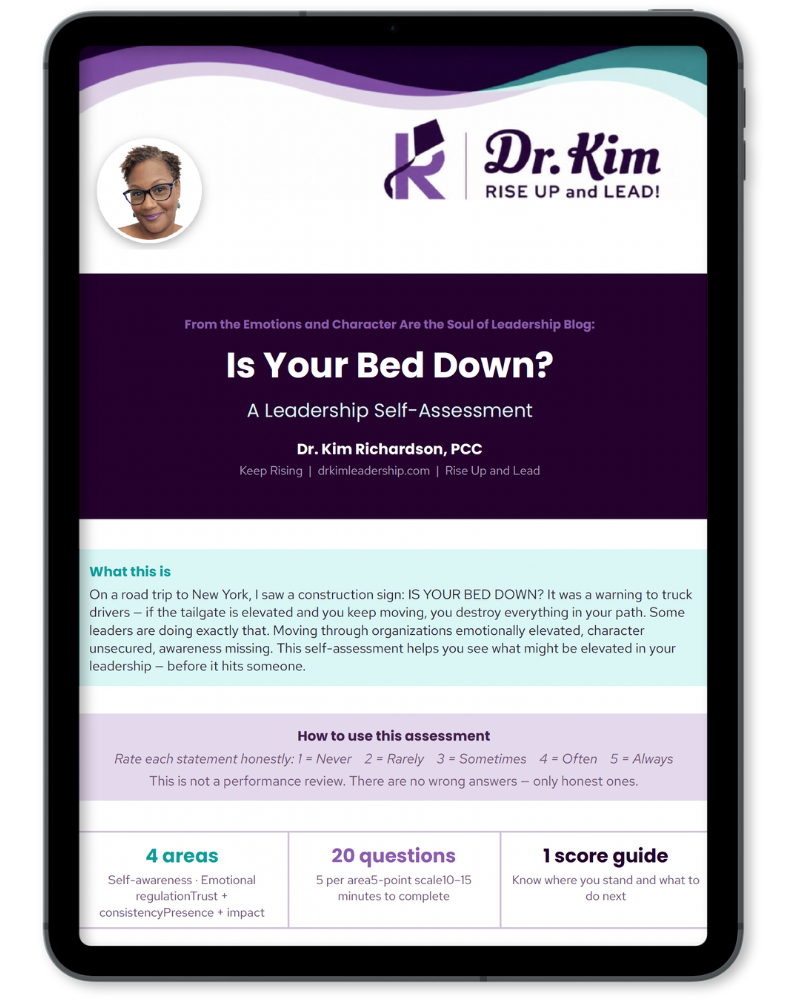
Dr. Kim Richardson | drkimleadership.com
I was sitting at the airport waiting for boarding to begin. If you’ve spent any time in an airport, you know there are different layers of communication happening around you. Each gate has its own agent making announcements. At the same time, TSA comes over the airport-wide speaker.
As I sat there, our gate agent began making announcements. Then suddenly, TSA came over the system at the same time, I assumed (haha) the gate agent would stop talking. NOPE. She didn’t. She just kept going.
Now both voices were speaking simultaneously. TSA was saying something about an item left behind while my gate agent was preparing us to begin boarding. I found myself trying to listen to two messages at once. Both sounded important. Both could have applied to me. Yet I couldn’t fully hear either one because they were competing for the same space.
The Leadership Connection
Leaders rarely struggle because they don’t have enough information. Most of us are drowning in it.
Data reports. Emails. Staff concerns. Parent complaints. Budget issues. Deadlines. Strategic plans. Feedback. Expectations. That’s before we consider our own internal dialogue.
At any given moment, multiple thoughts are competing for our attention:
→ One voice says, “You need to move faster.” Another says, “Slow down and think.”
→ One says, “Keep everyone happy.” Another says, “Do what’s right.”
→ One says, “Avoid the conflict.” Another says, “Have the conversation.”
The challenge is not that we lack voices. The challenge is determining which voice deserves the microphone. When everything is speaking at once, clarity becomes difficult. When everything feels urgent, discernment becomes essential.
“Emotions make announcements. Character decides whether they become instructions.”
Anxiety is making an announcement. Frustration is making an announcement. Fear is making an announcement. Just because an emotion is speaking does not mean it should be ignored — but it also does not mean it should automatically direct our behavior. Emotions tell us something is happening. They don’t always tell us what to do about it.
Character is what helps us pause before reacting. It helps us distinguish between what is loud and what is true. It reminds us that not every voice deserves equal influence over our decisions. Fear may be speaking. Character asks: What is the courageous response? Frustration may be speaking. Character asks: What is the productive response?
The loudest voice in the room is not always the wisest voice in the room. And leadership maturity is not measured by how many voices you hear — it is measured by your ability to discern which one to follow.
I keep thinking about how leadership is, in many ways, an attention problem. We’re not short on information or input or perspective. We’re short on discernment — the practiced ability to know which voice deserves the microphone right now.
This is why emotions and character are the soul of leadership.
Emotions are constantly making announcements.
Character determines which ones should influence our actions.
This week, pay attention to the competing voices in your leadership. Before you respond to a difficult situation, pause and sort the voices:
→ Which voice is based on fear?
→ Which voice is based on fact?
→ Which voice is aligned with your values?
Notice what changes when you create space between the announcement and your response. The quality of your leadership is often determined in that space.
- What competing voices are demanding your attention in your leadership right now?
- When you are under pressure, which voice tends to get the microphone — and is that the voice you want leading?
- If your character had the microphone in every leadership decision this week, what might you do differently?
Emotions and Character are the Soul of Leadership. And the soul of leadership is not found in having all the answers — it is found in developing the wisdom to know which voice deserves your attention and which ones are simply making noise.
Give the microphone to your character. Lead from there. (Sing if you want to:)
Rise up and lead.